International Ministries

Happy New Year!

January 12, 2004 Journal
Tweet

We have had an especially busy and productive holiday season this year.In addition to our normal celebrations of Christmas and New Year's Day, we've also been involved in the various activities being held to commemorate the bicentennial of Haiti's independence, which was achieved on January 1, 1804. Hence, this month's update on our regular activities will be supplemented with some extra articles and web links to help you learn more about this important event in Haitian and Caribbean history.

CAHN HOSTS CHRISTMAS DINNER FOR HAITIAN DETAINEES

After being postponed for a week due to various complications, the Committee of Assistance for Haitians in Need (CAHN) was successful in hosting a Christmas dinner for the detainees in the Carmichael Road Detention Center on December 17th.

Thirty-five detainees participated in the activity, including approximately 15 Haitians, 10 Cubans, 2 Nigerians, and a handful of Jamaicans, Mexicans and Ecuadorians.

In addition to providing the Christmas dinner, the members of CAHN also conducted a short worship service and distributed used clothing to the detainees.

Estela reports, "I was very overwhelmed by the gratitude of an Ecuadorian woman when she realized that I could speak Spanish.She told me that the next day she was scheduled to be deported to her country, but that as a result of our visit and encouragement she felt more confident about the uncertainty of returning home.I prayed with her and together we wiped off our tears."

The success of this activity has greatly increased the enthusiasm of CAHN's members and they are already in the process of planning a future activity at the Detention Center.

THEOLOGY STUDENTS GRADUATE FROM ATLANTIC COLLEGE

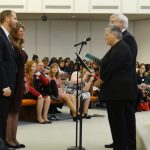
This year's graduating class from Atlantic College included four of Dan's students from the division of theological studies: Ian Keith Brathwaite, Sr., Donna Johnson, Vernita Josey, and Maria Bowe.Mrs. Josey was the valedictorian for this year's graduating class and Mrs. Bowe was the salutatorian.The students graduated on the evening of Monday, December 15th.

HAITIAN BICENTENNIAL CELEBRATIONS

This year Haiti celebrates 200 years of independence from France.This is an important milestone, not only for Haiti but for all Caribbean countries as well as all countries with a history of slavery.Haiti was only the second country in the Western Hemisphere (after the United States) to successfully achieve independence from its European colonizers.With the achievement of its independence, it also became the world's first black republic and the first country in modern history to abolish slavery.In spite of these proud accomplishments, Haiti still faces many great difficulties (see "Why Haiti is so poor?" below).

In Nassau, we were privileged to celebrate the Haitian bicentennial in the following ways:

1.On New Year's Eve, we attended worship services at Emmaus Haitian Baptist Church here in Nassau.Following the service, we celebrated with the congregation by eating soup joumou, Haitian bread, and hot chocolate (see "Celebration Soup" below).Then on New Year's morning, in keeping with Haitian tradition, we had our own soup joumou for breakfast that Estela had prepared special for the occasion.

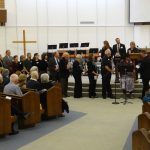
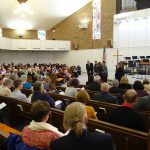
2.We attended an ecumenical service, held on Sunday, January 4, which was organized by the local Haitian churches to commemorate the bicentennial of Haiti's independence.

3.Last night, we attended a banquet, sponsored by the local Haitian community, in honor of Haiti's bicentennial.We were privileged to hear a dynamic presentation by the guest speaker, Massachusetts state representative Marie St. Fleur.Having fled Haiti's Duvalier regime with her family as a child, St. Fleur is now a naturalized U.S. citizen and the first Haitian-American to be elected to the Massachusetts state legislature.

CELEBRATION SOUP: HAITIANS MARK THEIR NATION'S INDEPENDENCE

"The Haitian people are proud of their glory. And as citizens of the first independent black country in the Western Hemisphere, they had to come up with a glorious dish to celebrate their independence day, Jan. 1, 1804. Therefore, for almost 200 years, joumou, Haitian yellow squash soup, has had to be the best on Jan. 1. The soup must measure up to the spirit of the day, to the beauty of our independence, to the nonstop celebration of our triumph.On Jan. 1 the soup must be brightly yellow and made with a lot of meat.Because yellow is the color that will make money flow into the household (according to superstition), Haitians will not miss their New Year's soup, no matter where they have migrated."

Read the full text of this article at:

http://www.webster.edu/'corbetre/haiti-archive/msg06201.html

THE HAITIAN REVOLUTION OF 1791-1803

"The shortest account which one typically hears of the Haitian Revolution is that the slaves rose up In 1791 and by 1803 had driven the whites out of Saint-Domingue, (the colonial name of Haiti) declaring the independent Republic of Haiti. It's certainly true that this happened. But, the Revolution was much more complex. Actually there were several revolutions going on simultaneously, all deeply influenced by the French Revolution which commenced In Paris in 1789."

Read the full text of this article at:

http://www.webster.edu/'corbetre/haiti/history/revolution/revolution1.htm

WHY IS HAITI SO POOR?

"The question I am asked most frequently is: WHY IS HAITI SO POOR? This is a difficult thing for people to understand, especially for those of us living in a country as rich as the United States. There are some very obvious conditions to note in Haiti's case: the long history of political oppression, soil erosion, lack of knowledge and literacy, a large populace in a small country. But a question of CAUSES for such poverty is extremely complex. I have tried to respond to the question in a manner that points up this incredible complexity."

Read the full text of this article at:

http://www.webster.edu/'corbetre/haiti/misctopic/leftover/whypoor.htm

RECOMMENDED READING

The Black Jacobins : Toussaint L'Ouverture and the San Domingo Revolution, by C.L.R. James

This powerful, intensely dramatic book is the definitive account of the Haitian Revolution of 1794-1803, a revolution that began in the wake of the Bastille but became the model for the Third World liberation movements from Africa to Cuba. It is the story of the French colony of San Domingo, a place where the brutality of master toward slave was commonplace and ingeniously refined. And it is the story of a barely literate slave named Toussaint L'Ouverture, who led the black people of San Domingo in a successful struggle against successive invasions by overwhelming French, Spanish, and English forces and in the process helped form the first independent nation in the Caribbean.

In 1789 the French colony of Saint Domingue was the most profitable real estate in the world. These profits came at a price: while its sugar plantations supplied two-thirds of France's overseas trade, they also stimulated the greatest individual market for the slave trade. The slaves were brutally treated and died in great numbers, prompting a never-ending influx of new slaves.

The French Revolution sent waves all the way across the Atlantic, dividing the colony's white population in 1791. The elites remained royalist, while the bourgeoisie embraced the revolutionary ideals. The slaves seized the moment and in the confusion rebelled en masse against their owners. The Haitian Slave Revolt had begun. When it ended in 1803, Saint Domingue had become Haiti, the first independent nation in the Caribbean.

C.L.R. James tells the story of the revolt and the events leading up to it in his masterpiece, The Black Jacobins. James's personal beliefs infuse his narrative: in his preface to a 1962 edition of the book, he asserts that, when written in 1938, it was "intended to stimulate the coming emancipation of Africa." James writes passionately about the horrific lives of the slaves and of the man who rose up and led them--a semiliterate slave named François-Dominique Toussaint L'Ouverture. As James notes, however, "Toussaint did not make the revolution. It was the revolution that made Toussaint."

This book is available from http://www.amazon.com and other online booksellers.

PRAYER REQUESTS

THANK YOU!

We greatly appreciate your support for our ministry.Wishing you a happy

New Year!

Serving Christ in the Bahamas,

Daniel and Estela Schweissing