International Ministries

David and Susan Brown serve in Ghana

September 19, 2011 Journal
Tweet

I Will Sing Of My Redeemer

Isaiah 43:1-3a; Colossians 1:13-14

September 18, 2011


First Baptist Church Midland is a wonderful church to serve. When I began to think about asking for a sabbatical leave, there was great support from the first few folks I floated the idea past.  Eventually, this sabbatical idea took form, and was voted on with great affirmation at a church business meeting.  And so we chose to spend 2 months in the country of Ghana, helping out at the Baptist Vocational Training Center in Frankadua.  The Ghana Baptist Convention also asked us to do a few other things, like teach for an intensive week at the seminary in Kumasi, a crash course on “Pastoral Care and Counseling”. This went very well, although I must confess, I was nervous at first. Then we also were asked to visit the Baptist hospital in Nalerigu, which is in the northern part of the country, close to Burkina Faso and Togo. 

But for now, I would like to share about our experiences at the Baptist Vocational Training Center, or the BVTC, as that is where we spent most of our time.  The BVTC has roughly 70 students. There were 36 students who lived in boarding this summer; they call them “inmates”. The rest of the students came daily from several surrounding towns, and left around 3 pm each day. All the students are female, except for 5 boys, who were part of the commuters.  The students were grouped together by the particular vocation they were studying, which included catering/cooking, dress-making/sewing, hair-dressing, batik-making, carpentry, computers, and kente weaving (using a hand loom and weaving patterns). The vast majority of students were in catering and dress-making.  

The students are there for 3 years, learning their trade. When they graduate, they go out into the world to make their way. If they are in dress-making, they are given a new sewing machine and some supplies to get started. If they are in catering, they are given a new 2 burner gas stove, and some cooking utensils.  The whole idea is to give them a skill which they can then use to make a positive contribution to society, and also help them feel positively about themselves.

Of the 36 girls who were in boarding this summer, we learned that 31 of them came out of the trokosi tradition.  In certain parts of Ghana, and also Togo and Benin, there are villages where people have animistic beliefs, and worship idols. They believe that the gods need to be appeased if there is some calamity that befalls anyone.  Trokosi is a form of human slavery, whereby families will give a virgin daughter to a religious shrine to atone for various sins or infractions of the family.  This may be something as simple as loss of property and income, which is thought to be controlled by making a sacrifice to the gods. Many of the shrine slave girls are required to do heavy physical labor like cultivating fields with a hand hoe. Other common duties are weaving mats, making and selling firewood (with all profits going to the priest or the shrine), fetching wood and water, sweeping the compound and attending to the images of the gods . For the most part, any money that is earned by selling produce is turned over to the priest. The trokosi slaves have all their rights taken away. They are not given clothes, medical attention, food or shelter, and are oftentimes not allowed to attend any educational facility.  They are also exploited sexually, and if they get pregnant, they are often denied any pre-natal care. Any children that are borne to them become property of the fetish priest as well.  

It is a deplorable situation, and one which the government of Ghana has  addressed by passing a law which prohibits its practice. However, these things take time, and trokosi is still going on. 

So, how are these girls liberated? Sometimes they run away, but that is very rare. Mostly, they are bought back. Every year, the Ghana Baptist Convention is able to identify a number of trokosi slaves, and pays a ransom to free them.  Then they are enrolled at the Baptist Vocational Training Center.  Some of the girls at the BVTC are 2nd and even 3rd generation trokosi, whose mothers, and even grandmothers, were forced into this life of slavery.  When the girls are set free, there is concern by the villagers who hold to their animistic beliefs, that the original family will undergo tremendous calamity, set upon them by the gods. When this doesn’t happen, and the family and villagers see the girls now healthy and happy and pursuing a viable future, the old superstitions begin to die away. But all this takes time.

Can you begin to see the importance of the Baptist Vocational Training Center? Rev. Grace Akunor, who is the head of the school, is a woman who has a very deep faith in God, and a love for these girls that is remarkable. You may recall that she was with us a year ago, and shared in our worship service. The Ghana team from last year also has a very high regard for her and her passion.  Rev. Grace is doing a wonderful work in Ghana, and we were so privileged to be at the school with her, getting to know the other teachers, and of course, the girls themselves.

The girls, young women really, are given clothes, food, and shelter; the basics of human need. But they are also given love and care,  which some of them have never known. The gospel is shared with them, and there are daily devotional times, both before school begins each morning, and in the evening before going to bed. These were the times that Susan and I often were called upon to share leadership in. 

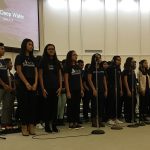
The joy of the girls is palpable. It is obvious and evident. One thing that Susan and I both observed is that they sing virtually all the time. They sing when they prepare food, they sing when they carry water, they sing when they are learning a new skill, they sing and dance and always put a smile on our faces. And it was infectious. We couldn’t help but join them in singing and dancing. We were able to teach them some songs, and we learned some of their songs as well.

For many evenings, I led the devotional time with lots of songs, and I would choose a biblical story about a woman of faith from the Bible. I wanted to illustrate for them that women are used by God in a mighty way in the scriptures, and that they have a future and a purpose in this life as well as men. We always ended with a prayer time, holding hands in a circle, each girl praying aloud with gratitude for the day and for their school, and then we would end by singing “Be Bold, Be Strong”.  Then there were the good night hugs, which were offered freely. We were referred to as “mommy and daddy”, and the bonds became quite strong. I suppose it would be no great surprise to tell you that when it came time to leave, the tears flowed easily on both sides.

You see, they truly know and understand the meaning of redemption. They are genuinely joyful because they are so thankful. They have experienced the love of God, and are not afraid to sing about it, loudly and with enthusiasm. 

In our Christian faith, we sometimes talk about the concept of redemption. But the truth is that most of us don’t really know what redemption is all about. The biblical meaning of redemption paints a picture of a God who rescues us from the power of a kingdom of darkness, and the burden of a sinful, lost condition, in which we were held as slaves.  A ransom has been paid for our freedom, and it has been paid by God’s Son, who has given His life for us. We have been redeemed. We have been bought back from a life of slavery to sin and death. This wonderful work of redemption was borne out of love, God’s love for the whole world. You and I have been set free from the burden of sin by Christ’s sacrifice. We have been saved. We have been loved. We have been bought back. We have been released. We have been delivered and set free. We have been emancipated and liberated from sin’s consequence.  We have been forgiven. God has called us by name. We are his. We belong to Him. Through the blood of Christ, the ransom for sin has been paid.  We have been redeemed. Amen.


These girls from the Baptist Vocational Training Center know the power of being bought back from a life of slavery, in a very literal fashion. They have been redeemed, and they are not ashamed to sing about it.  Our lives have been enriched by our experience in Ghana. We will always be grateful to First Baptist Church Midland for supporting us in this sabbatical. And we are witnesses to the fact that God is doing a mighty work in our world, and especially at the BVTC in Frankadua, Ghana. Amen and amen.


To read about the whole experience and watch a video of the Kitchen/Dining Hall Dedication go to http://fbcghana2010.com/blog/